How we build software: our 24*7 software factory
Engineers don’t work 24*7. Our software factory does. Engineers decide and answer for the result; the factory builds, tests and security-checks code around the clock.
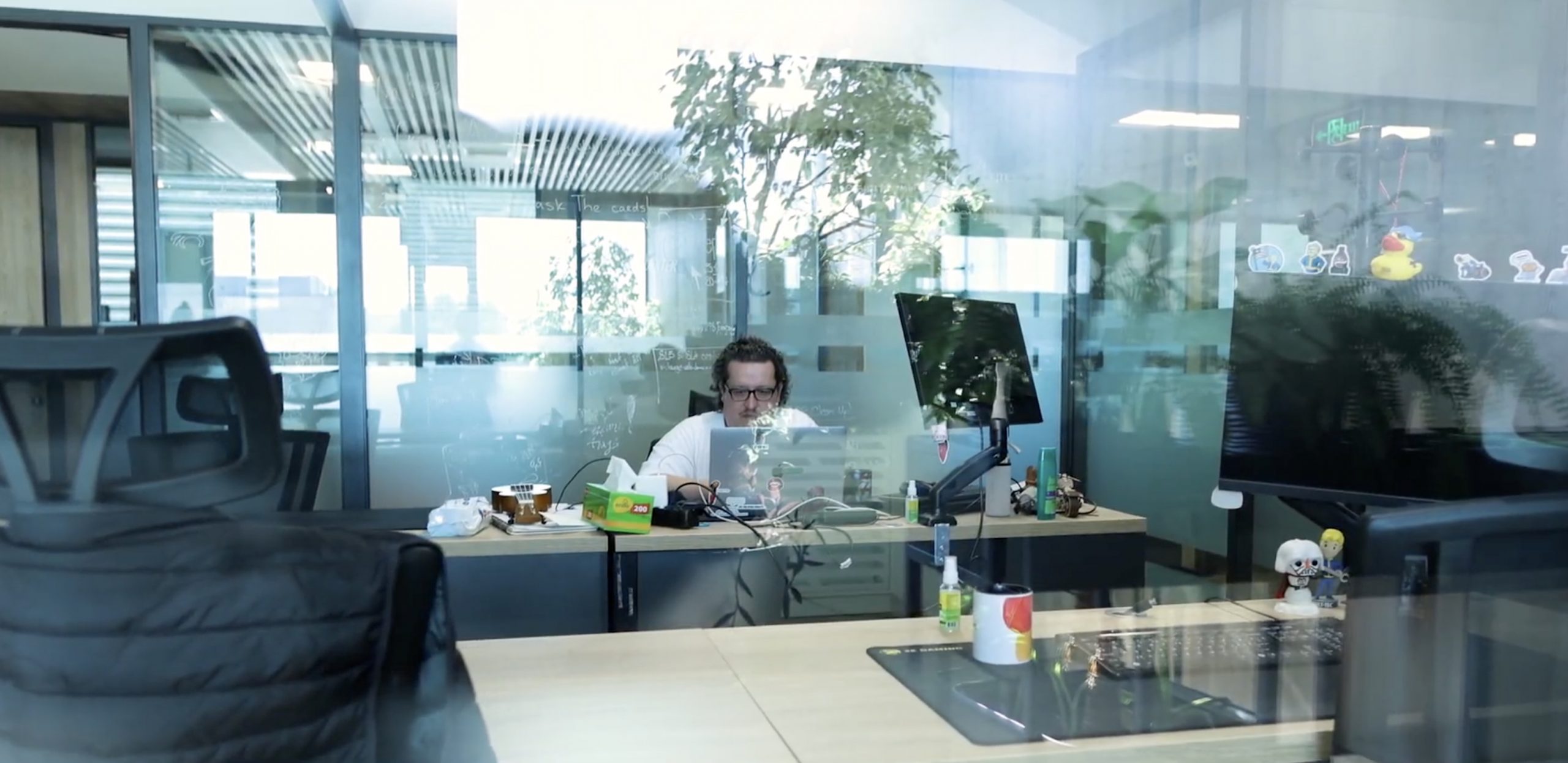
Here is exactly how your software gets built at FusionWorks: who decides, what runs overnight, how every change is checked, where AI runs, and what you get every week.
Engineers decide
Every project has a named delivery lead and senior engineers who own the architecture, the quality and the result. They hold the gates the factory can’t pass on its own:
- the spec: what gets built and how we will know it works;
- the architecture and every decision that is expensive to undo;
- every merge: nothing ships without an engineer’s approval;
- every release to production.
The factory builds, overnight
Our software factory takes the scoped work engineers approved during the day and runs it through the same line every night: spec → code → review → tests → security checks → documentation.
In the morning the team gets a report: what was built, what passed, what needs a decision. Engineers review it, then approve or send it back.
Engineers don’t work 24*7. The factory does, on every engagement, staff augmentation included. You pay for engineers’ hours; the overnight work is included.
Security on every change
Security isn’t a promise. It’s a process TÜV Austria audits every year.
- every change is security-checked before it ships;
- AI-written code gets the same security review as any other code;
- you get our security reports and hear about a risk from us first;
- the whole process runs inside our ISO/IEC 27001:2022 and ISO 9001:2015 systems, certified by TÜV Austria.
Attackers automate now. So do our security checks. How we secure your code and data.
Where AI runs
AI runs where your data is allowed to go. We choose it per project, with you, by data class:
- public and non-sensitive code and documents: frontier models under terms that exclude training on your data;
- sensitive data: private models on our ISO-certified servers or on yours.
What you get
- a named delivery lead who owns the result;
- weekly demos of working software;
- for new work, a fixed price with acceptance criteria signed before we start;
- a team that ships more per paid hour, because the factory does the routine.
Proof
- Ops, our own ERP: built in one week; the whole company has worked in it since September 2026.
- Allasso: 100 features in two years with a team of one to two engineers.
- MSP Triage: AI agents 20× cheaper per conversation than the human service they replaced.
What AI-Native means in practice
This is a deliberate bet. While most companies bolt AI tools onto existing processes, we redesigned the process itself. Every workflow, every team structure, every quality gate is engineered for a world where AI writes a significant part of the code and humans provide the judgment, architecture, and standards that make it production-ready.
Strong engineers, not cheap labour. When AI handles routine implementation, the value of an engineer shifts. We hire people who think well – who understand real customer problems, make architectural decisions, and iterate fast. Curiosity, judgment, and speed of learning matter more than typing speed.
Systems and workflows, not chaos. AI amplifies whatever you feed it. Feed it chaos, and you get faster chaos. Feed it a structured, factory-like process – with clear quality gates, defined architecture, and repeatable standards – and you get consistent, reliable output at speed. We chose the second option.
Smaller teams, faster cycles. The old agency model scaled by hiring. More people, more revenue, more coordination overhead. Our model scales differently: strong engineers + strong process + strong AI automation. Smaller teams move faster, deliver more, and maintain higher quality.
Architecture and judgment, not endless manual implementation. Human experts design the workflows, quality gates, architecture, and decisions. AI helps us deliver faster, with more consistency and less waste. This isn’t about replacing engineers — it’s about removing the parts of the job that didn’t require engineering in the first place.
Production-ready standards, not demo-level hype. Anyone can build something that looks real using AI. Then reality hits: authentication, payments, data migrations, CI/CD, security, performance. We bridge the gap between prototype and production — with the speed and cost-efficiency that AI-native delivery enables.
The shift we’re making
Traditional outsourcing was never a great scalability story. Revenue grew with headcount. Margins stayed thin. Everything was people-dependent.
We’re building something different – a tech company with its own way to develop software. A factory-like process, engineered by humans, automated by AI. We own the process, the expertise, and the technology behind delivery. That’s how an outsourcing company becomes a real tech partner.
Better systems, not bigger teams. The future of software development is not bigger teams. It’s efficiency built with systems.
And we’re already there.
Are you joining? Email us at info@fusionworks.md