How we partner with product teams: the Allasso story
Most traders make decisions somewhere between using a spreadsheet and their gut feeling. One is too slow to keep up with the market, the other is too expensive to be wrong about. When Allasso came to FusionWorks, they wanted to give financial professionals a third option: a workspace where a trade could be tested, stress-checked, and understood before any real money moved.
What you are about to read is less a portfolio piece and more a description of how we work. Allasso is the example, but the pattern is the point. We treat companies that hire us as long-term product partners, and the work below is what that looks like when it plays out over a couple of years.
Starting small, on purpose
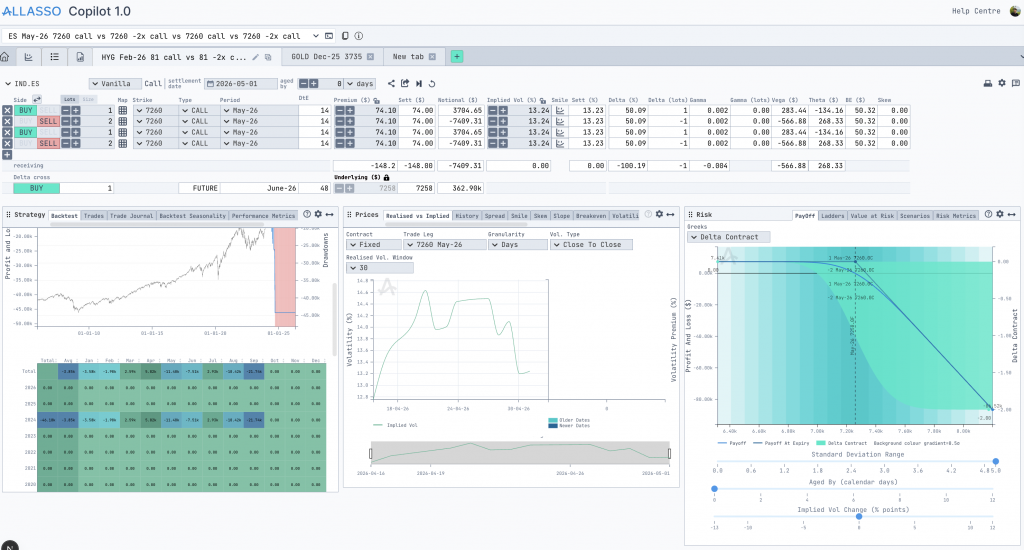
The first version of the product did exactly one thing: the trader picked a single instrument, for example, gold or the S&P 500, and ran “what if” scenarios against it. They could change the price, the volatility (the number traders watch to guess how wild the market is about to get), and the inputs that drive the market underneath, then watch the consequences update in seconds.
The work that used to live in a spreadsheet, calculated by hand and prone to small errors with large costs, now happened inside a tool built for the job. Assumptions could be tested instead of being guessed.
We could have proposed a much bigger first build but we didn’t. Because a smaller first version meant Allasso’s users could touch the product sooner and tell us what was actually missing. That early feedback is what shaped every decision after it.
Letting the product grow from real usage
As traders spent time inside the tool, they started asking for more context around each decision, so we built outward in layers rather than starting over. Historical charts came in to ground the scenarios in what the market had done. Risk analysis arrived next, then calculated outputs, followed by new ways to look at the same trade from different angles. Each addition wrapped around the existing workflow instead of replacing it, which meant nobody had to relearn a tool they already trusted.
This is the part of the partnership we care most about. It is easy to build the thing on the brief. It is harder, and more useful, to keep building in a direction that respects what users have already learned.
Knowing when to throw something away
The first version of the charts was built with a tool called Plotly. It got us moving fast, which was the right call at the time. But as traders pushed the product harder, they needed charts that behaved in very specific ways.
So we moved to D3, which gave us full control over how every chart looked and how every interaction behaved. That switch unlocked the visualizations we couldn’t have built before, and it set up everything that came after. Part of being a real partner is telling a client when it is time to replace something we built ourselves, and then doing the replacing without friction for the users.
Growing past the original scope
Over the last year, the product has grown well beyond the single-screen tool we started with. Together, we built two new modules that opened up entirely new ways of working.
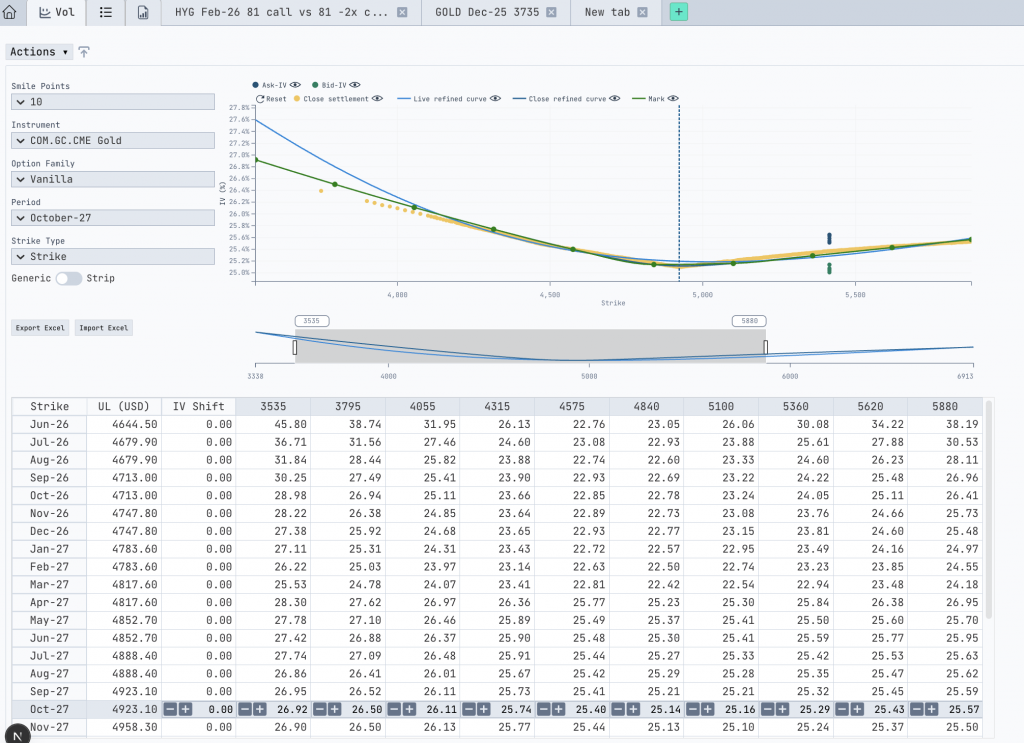
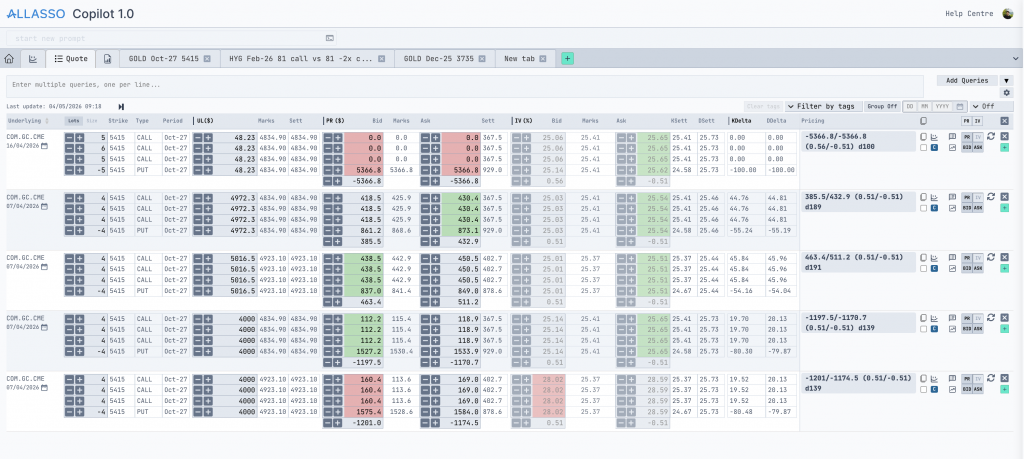
The first, Quotes, lets traders work with several instruments at once. They could compare positions side by side, edit quote structures, and recalculate multiple positions inside a single workflow instead of jumping between tabs. The second, Volatility, gave traders direct, visual control over volatility surfaces and smiles (the maps traders use to price options across different scenarios). They could adjust values by hand, publish the structures they built, and reuse those calculations elsewhere in the platform.
Around this point, something quietly important happened. The separate pieces of the product started talking to each other, and the workspace stopped feeling like a collection of features. It started feeling like one connected environment, which is exactly what a trading tool needs to be.
Meeting traders in their own language
Once the platform was mature, we kept noticing the same small friction – when a trader has an idea, they describe it in shorthand: the thing they want to trade, the period, a few numbers, whether they are betting on the price going up or down. Then they sit down at the screen and translate that shorthand, click by click, into a structure the system understands. The idea is fast. The data entry is slow.
So we built an AI-powered structure recognition directly into the application. A trader can type their idea the way they would say it out loud, naming the underlying (the asset the trade is based on, like gold or an index), the contract period, the strike prices (the price levels where the trade pays off), the quantities, the call and put legs (the individual up-bets and down-bets that make up the position), and the target price. The system reads that shorthand and turns it into a fully formed structure inside the app, ready to test.
The result is a workspace where structure creation is faster, manual input drops, and the tool finally meets traders where they already are, instead of asking them to translate themselves into it. This is the philosophy the whole partnership has run on: watch how the work happens, then shape the product around it.
What we are building next
Today, charts, quotes, volatility analysis, shared structures, exports, and trading calculations all live inside one connected ecosystem. FusionWorks is still building with Allasso, and the next phase is taking some of the individual chart and analytics components out into standalone libraries so they can run anywhere: JavaScript apps, Python notebooks, future trading products that have not been designed yet.
The product started as one instrument on one screen. It became a set of tools shaped around the way traders work – 100 features built across 700 tasks, because the team behind it kept pushing the boundaries and we kept showing up with the right solutions. That, more than any single feature, is what we mean when we say partnership.